
On 23 November Anthropic launched Claude Ship. It is three agents: Code Review, which was already generally available; PR Steward, which fixes failing checks and review feedback; and Claude Approvals, which reads a policy the team writes and decides which pull requests Claude may approve on its own.
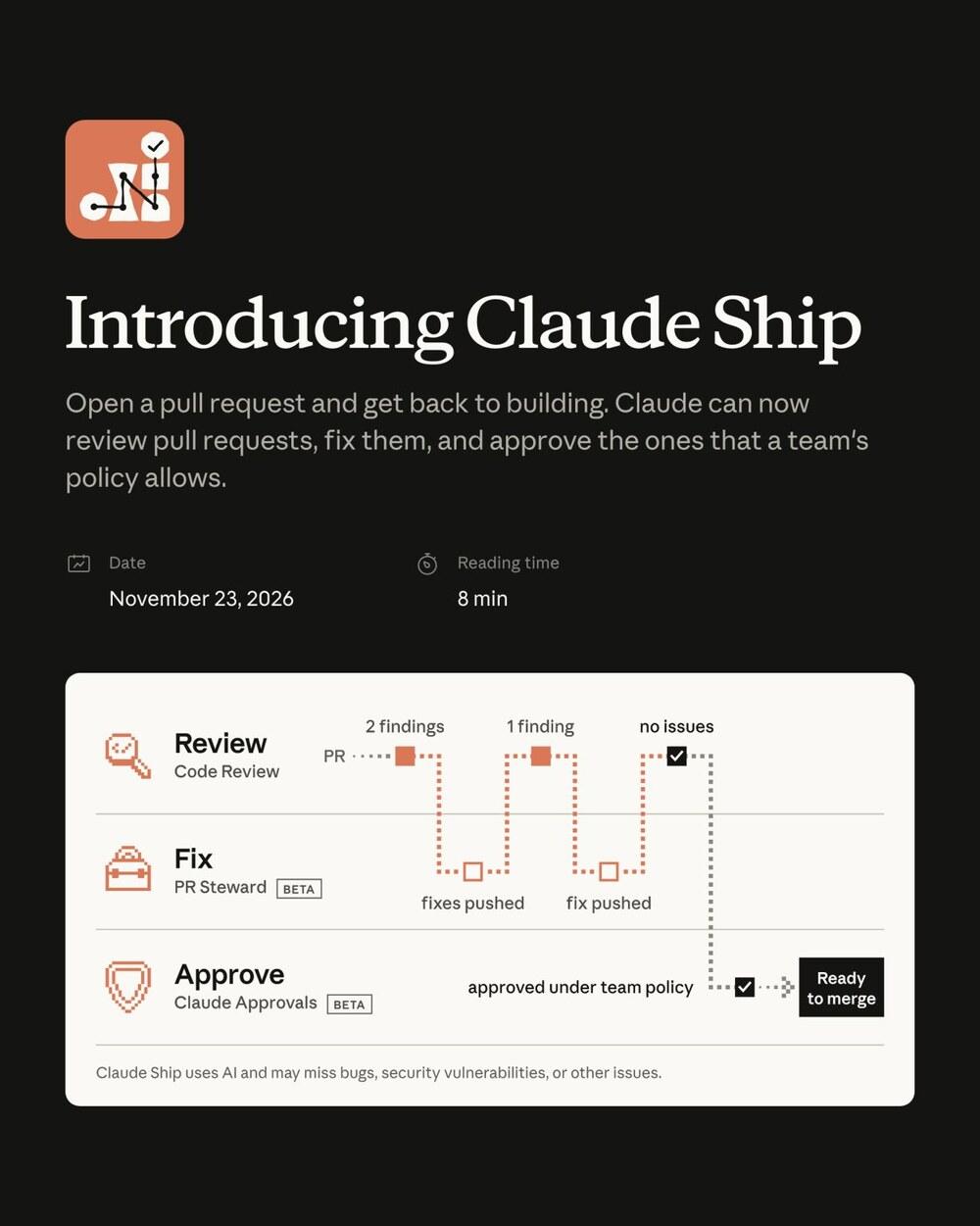
Image: Anthropic, from the Claude Ship announcement.
The first thing we thought on reading it was "that's our review policy". Coderbuds has posted a check beside CI saying how much review each change needs since 1 November, approved the changes the policy lets through without a person since 13 November, and told the coding agent to merge once a pull request is ready since 15 November.
The second thing we thought was more useful. Our own production numbers already said that 92% of our merged pull requests were written by an agent. Everyone building this way hits the same wall at the same time: the code arrives faster than anyone can read it. It would be odd if the company whose agent writes the code did not try to fix what happens after the pull request opens. So rather than a "they copied us" post, here is an honest one: where Claude Ship is ahead, where we made different choices, and where Coderbuds fits now.
#Where Claude Ship is ahead
It fixes things. PR Steward picks up failing CI, merge conflicts and review comments, pushes a fix, and tells you how to undo it. Coderbuds does not push code, and does not want to. If you want an agent working your branch until it is green, that is Claude Ship's job, not ours.
Its policy language is far more expressive. Claude Approvals reads a YAML file in the repository: rules on paths, how many people each needs, conditions on facts like pr/diff_lines, policy files per directory, and classifiers you write in natural language. It can even keep earlier approvals after a push when a classifier judges the new diff to have the same intent. Coderbuds offers three policies, a list of sensitive paths, and one or two approvers for risky changes. That is deliberately simpler, and it is less flexible.
It is one product from the people who make the model. If your team writes everything with Claude Code and reviews everything with Claude's Code Review, Claude Ship is one bill, one settings page and one vendor. That is a real advantage, and we would be lying if we said otherwise.
#Where we agree
Both start from the idea that a docs fix and a billing change should not wait in the same queue for the same person. Both post a real approving review, so a branch rule requiring one approval follows the policy. Both take that approval back when a push changes the diff. Both treat the files that decide how review works as needing a person. And both suggest watching before enforcing: Claude's observe mode, our check staying advisory until you turn on Hold merges until the review is in.
#Where we differ
#Coderbuds doesn't care which agent or model wrote the code
This is the one that matters most.
Claude Ship's approvals read Claude's review, its fixes come from Claude, and it runs on Claude Team and Enterprise plans, billed on Claude tokens. That is a sensible product for a model company to build. It is also a review process that only works fully when everything in it is Claude.
Most teams we talk to are not like that. One developer is on Claude Code, another on Cursor, a third tried Codex last week, and Copilot reviews everything because it came with GitHub. Coderbuds sits across all of it:
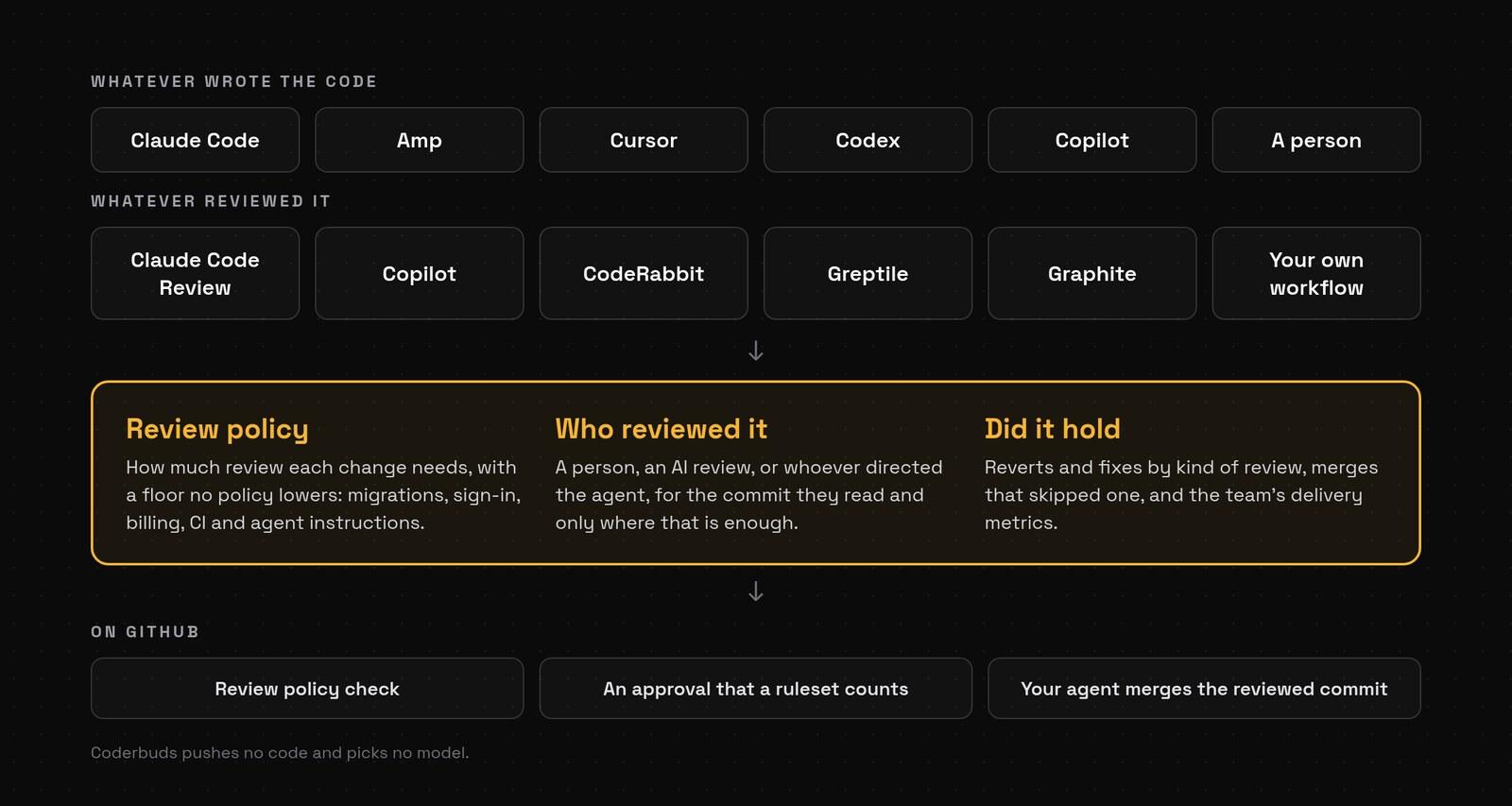
- Any coding agent. Claude Code, Amp, Cursor, Codex and Copilot report the changes they wrote through our MCP server, and Coderbuds infers the rest from the diff.
- Any AI reviewer. Anthropic's own Claude Code Review counts. So do Copilot, CodeRabbit, Greptile and Graphite, your own review workflow on whichever model you like, or Coderbuds' triage on repositories that have none.
- No model of our own to sell. The policy decides how much review a change needs, not whose model provides it. If you switch agents next quarter, the policy, the history and the numbers stay where they are.
#Whether the author counts as a reviewer
In Claude Approvals, the pull request's author can fill a seat without approving. The docs say plainly that with seats: 1, the author alone can meet it and nobody else has to look. To keep authors out, you write [humans, "!pr/authors"].
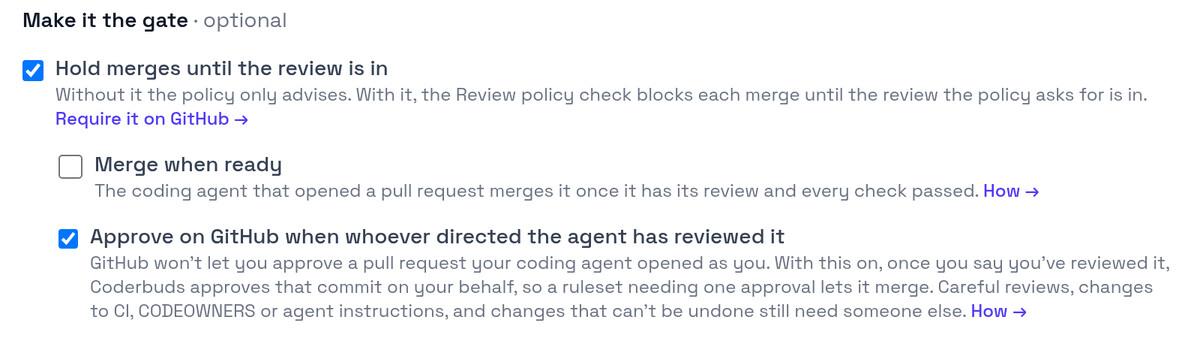
We came at this from the other side. GitHub will not let you approve a pull request that your coding agent opened as you, and that blocks everything on a small team. So we let your review count, but only on these terms:
- an agent reported writing all of the change, because a person who wrote some of it is its author;
- the review is of the latest commit, because an agent that pushes again has written something nobody has read;
- the change does not need a second reader: a two-person review, a change to CI,
CODEOWNERSor agent instructions, or one that cannot be undone.
Turning that into a GitHub approval is a separate setting, off by default, and the approval names the person it stands for.
#A floor no policy can lower
With a rule language, every team writes its own floor. Claude Approvals protects its policy file, CODEOWNERS and REVIEW.md by default, and its docs say not to rely on anything else being protected. Coderbuds gives a person, under every policy, database migrations, sign-in and permissions code, billing, dependency manifests, a newcomer's first change, and anything the analysis flags as impossible to undo or as swallowing its own errors. You can add to that list. You cannot quietly write it away.
#Did it actually hold up?
Letting changes through without a person is a bet. Claude Ship decides; nothing in its announcement or docs tells you afterwards whether the bet paid off.
That is what Coderbuds was built for before it ever approved anything. The review policy is one part of a team insights product: delivery and DORA metrics, pull request flow and bottlenecks, and how much of your code AI wrote. For review specifically, the dashboard counts how many changes merged on an AI review alone or needed none, the share that got the review they needed, and how often each kind was later reverted or fixed. Anything that merges without the review it needed is called out in your team's channel. If the bet is losing, you see it and tighten the policy. If it is winning, you have the evidence to loosen it.
#Side by side
| Claude Ship | Coderbuds | |
|---|---|---|
| Coding agents | Built around Claude | Any: Claude Code, Amp, Cursor, Codex, Copilot |
| AI review that counts | Claude's Code Review | Claude Code Review, Copilot, CodeRabbit, Greptile, Graphite, your own, or ours |
| Policy | YAML rules, classifiers, per directory | Three policies, sensitive paths, one or two approvers |
| Author as reviewer | Fills a seat by default | Only for an agent's whole change, latest commit, and not on risky changes |
| Fixes failing checks | Yes, PR Steward pushes commits | No, it never pushes code |
| Measures outcomes | Not that we could find | Reverts, fixes and delivery metrics by kind of review |
| Pricing | Claude tokens, including observe mode | Part of the Coderbuds subscription |
#So which should you use?
If your team is all-in on Claude and wants an agent that fixes the branch and a policy language to match, Claude Ship is very good, and you can still run Coderbuds beside it: we count Claude Code Review as an AI review today.
If your team uses more than one agent, or more than one reviewer, or you want a sensible default you can turn on in a minute and evidence afterwards of whether it is working, that is the layer we are building. Read how the review policy works.